
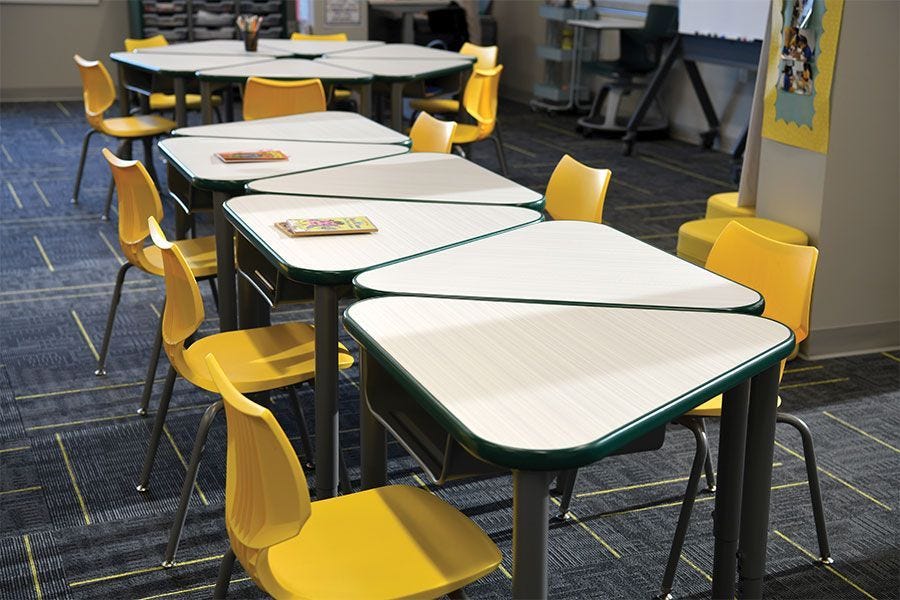
When people think “collaborative desks,” they often picture trendy shapes pushed into pods. But what matters most in day-to-day teaching isn’t the shape—it’s how quickly the room can move.
In fact, collaborative desks aren’t just furniture—they’re classroom choreography. When the layout supports smooth transitions and easy circulation, teachers spend less time managing the room and more time teaching.
In our Collaborative Desks Buying Guide, we break down how collaborative desks are designed to cluster, nest, and reconfigure so classrooms can shift between mini-lessons, partner work, and small groups without losing time (or momentum).


The teacher loop: the simplest layout upgrade that pays off daily
One of the most practical takeaways from our guide is this: collaboration works better when your layout eliminates bottlenecks.
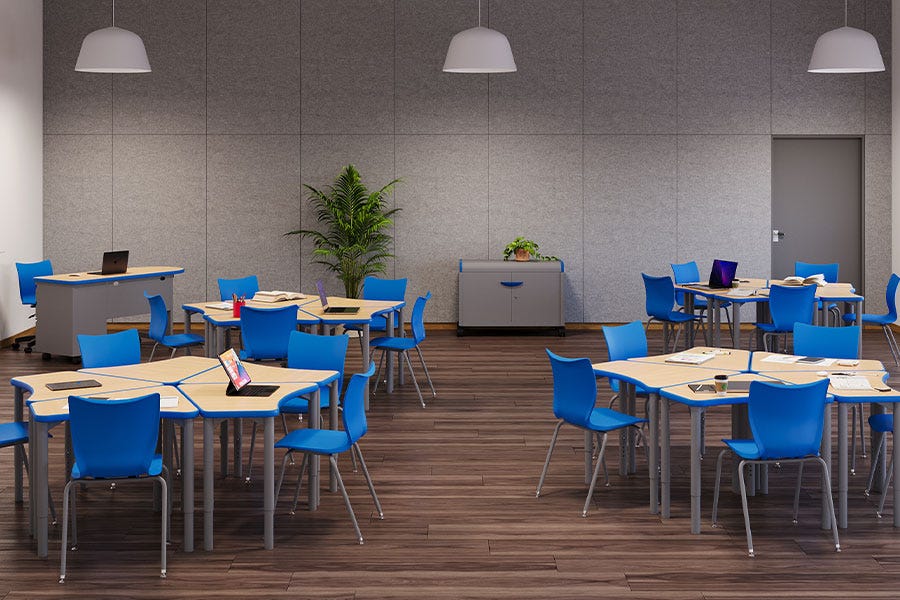
That’s why we recommend planning for a continuous teacher loop—a clear circulation path that lets you reach every group easily—and protecting accessibility by keeping at least 36" aisles throughout the room.


When you design around movement and sightlines, educators tend to see immediate benefits:
- Easier supervision without hovering
- Faster support for groups that get stuck
- Smoother transitions with fewer “traffic jams”
Quick layout check (before you buy)
If you’re comparing desk shapes, bases, or mobility, ask:
- Can I reach every pod without squeezing between chairs?
- Can students move to stations/materials without crossing through another group?
- Where do backpacks and supplies land—are walkways protected?
Choose desk shapes based on how you teach
In our guide, we outline how shapes like trapezoid, wedge, triangle, kidney, and hexagon can support common grouping sizes (2–6+), depending on how often you rotate stations, run seminars, or build project teams.
A simple way to approach it:
- Start with versatile shapes that can form multiple configurations
- Add specialty shapes only where they strengthen instruction zones (STEM pods, intervention corners, etc.)


Don’t skip durability—shared-use desks need shared-use materials
Collaborative desks get used hard: chairs scrape in, surfaces get wiped down, and tables get moved constantly.
That’s why our guide emphasizes choosing materials and construction that hold up to daily classroom life—especially when you’re planning for flexible layouts that change throughout the week.
Want the deeper dive?
This post zoomed in on one high-leverage idea—layout flow (the teacher loop + protecting 36" aisles)—because it’s often the difference between a classroom that looks collaborative and one that runs collaborative.
If you’d like to explore desk types, shapes, mobility, materials, and care in more detail, check out our Collaborative Desks Buying Guide for the full deep dive.


